
Slag & AshTrade Europe 2026: Where SCMs, Decarbonization and CCUS Come Together
The cement industry is entering a period where decarbonization, material availability, regulation and competitiveness can no longer be addressed separately.
Supplementary cementitious materials (SCMs) are becoming increasingly important to lower-carbon cement production, while changing trade flows and supply dynamics are creating new challenges for producers and buyers. At the same time, technologies such as carbon capture, utilization and storage (CCUS) are moving closer to industrial-scale deployment.
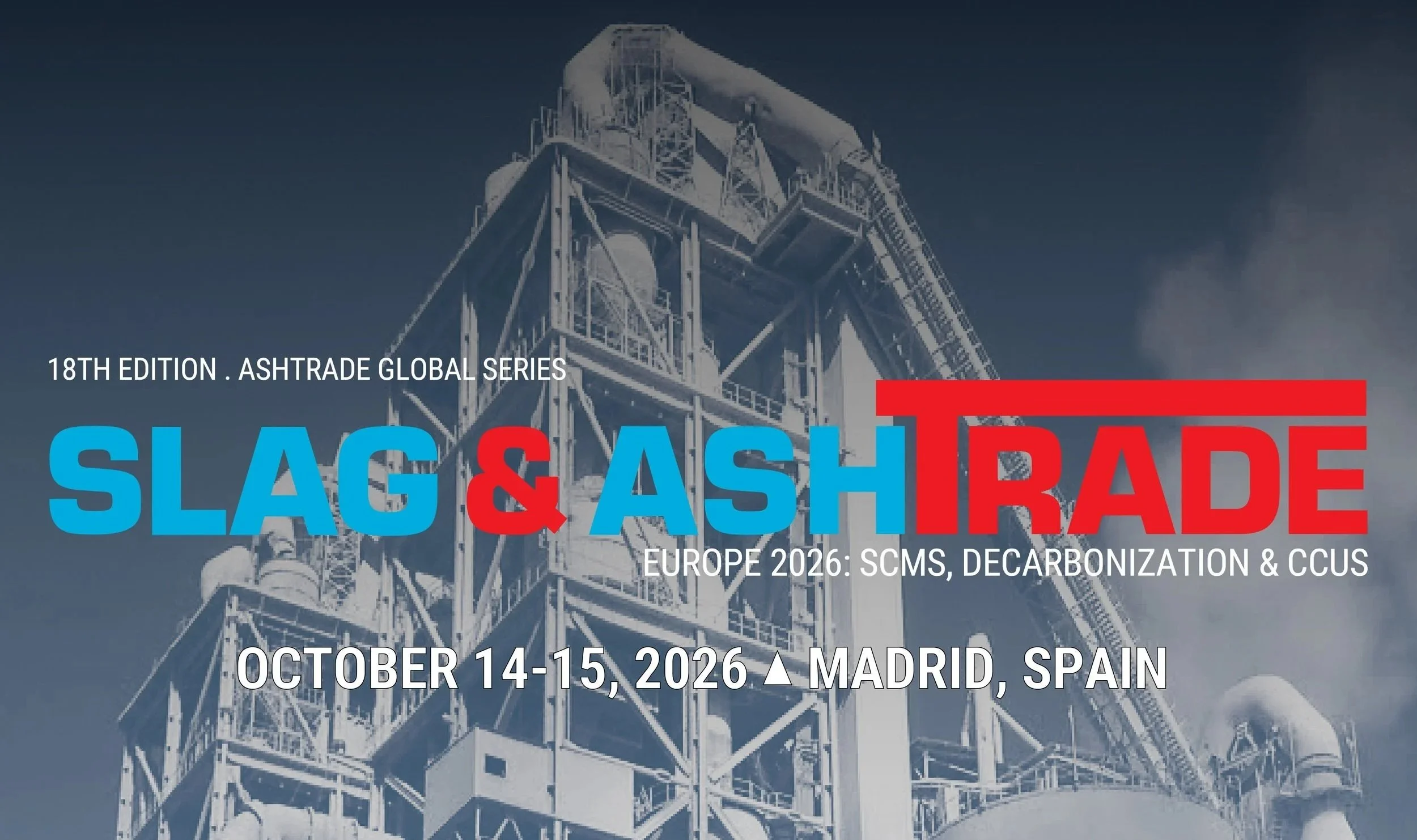
These developments will be at the center of Slag & AshTrade Europe 2026: SCMs, Decarbonization & CCUS, taking place in Madrid, Spain, on October 14–15, 2026.
The 18th edition of the AshTrade global series will bring together participants from across Europe, the Middle East and Africa to examine how the slag, fly ash and cement industries are responding to a rapidly changing market.
SCMs Move Further Into the Decarbonization Strategy
Reducing clinker content remains one of the most practical pathways toward lowering the carbon intensity of cement.
This places materials such as slag and fly ash, alongside other SCMs, at the center of the industry's transition. But increasing SCM use also raises important questions around availability, quality, processing, transportation and long-term supply.
As traditional sources change and demand for lower-carbon materials grows, securing reliable SCM supply chains is becoming both a sustainability and commercial priority.
At Slag & AshTrade Europe 2026, these challenges will be examined alongside global SCM trade flows and the increasingly interconnected cement, steel and energy value chains.
Regulation Meets Competitiveness
Decarbonization is also reshaping the economics of cement production and trade.
The conference will explore CBAM and industrial competitiveness, looking at the implications of evolving regulation for costs, trade flows and market positioning.
For cement manufacturers, traders and suppliers, the question is no longer simply how quickly emissions can be reduced. The industry must also determine how to make that transition while maintaining competitive operations and building resilient supply chains.
The event's high-level discussions will bring regulation, industry and investment together to examine what a sustainable transition can look like in practice.
From Low-Carbon Cement to Emerging Technologies
The transition will require more than a single technology or material.
Dedicated sessions at Slag & AshTrade Europe 2026 will examine the evolution of low-carbon cement, including new materials, SCMs and emerging pathways toward decarbonization.
Technology and innovation will also play a central role, with discussions covering beneficiation, separation technologies, next-generation processing and the integration of new solutions into existing industrial operations.
The focus is not only on what technologies are available, but how they can be implemented at scale.
CCUS Moves Toward Industrial Reality
For emissions that cannot be eliminated through efficiency, alternative fuels or clinker substitution alone, carbon capture, utilization and storage (CCUS) is becoming an increasingly important part of the industry's long-term decarbonization strategy.
Slag & AshTrade Europe 2026 will look beyond the concept of carbon capture to examine the transition from pilot projects toward industrial-scale deployment.
This creates a broader discussion around technology readiness, infrastructure, investment and the conditions required to make large-scale carbon capture commercially and operationally viable.
Two Days Connecting the Entire Value Chain
The conference is designed to bring together the different parts of the industry that will ultimately need to solve these challenges together.
Cement and lime manufacturers, slag and fly ash producers and traders, power generation specialists, shipping and logistics companies, beneficiation technology providers, environmental consultants, regulators, recycling professionals and infrastructure stakeholders will have the opportunity to exchange market intelligence and develop new business relationships.
Across the two-day program, discussions will move from regulation, markets and innovation to CO₂, global value chains and the outlook toward 2030.
Beyond the conference sessions, Slag & AshTrade Europe 2026 will provide structured networking opportunities for participants to connect with decision-makers across the international slag, ash and cement industries.
Join the Industry in Madrid
The transition toward lower-carbon cement is changing how materials are sourced, processed, traded and valued.
SCMs, CCUS, regulation and global trade are increasingly becoming parts of the same conversation.
Slag & AshTrade Europe 2026: SCMs, Decarbonization & CCUS brings that conversation to Madrid on October 14–15, 2026, connecting the companies, technologies and decision-makers shaping the next phase of the industry.
Explore the full agenda, conference details and registration options for Slag & AshTrade Europe 2026:
https://www.gmiforum.com/conferences/slag-ashtrade-europe-2026-scms-decarbonization-ccus
Secure your place in Madrid and join the conversation shaping the future of SCMs, low-carbon cement and CCUS.