
Scaling Up Carbon Capture: Rohrdorfer Doubles CO₂ Capture Capacity
Carbon capture is becoming increasingly important in the cement industry’s decarbonisation efforts. A recent development at Rohrdorfer’s cement plant in Germany shows how these technologies are progressing beyond early pilot testing.
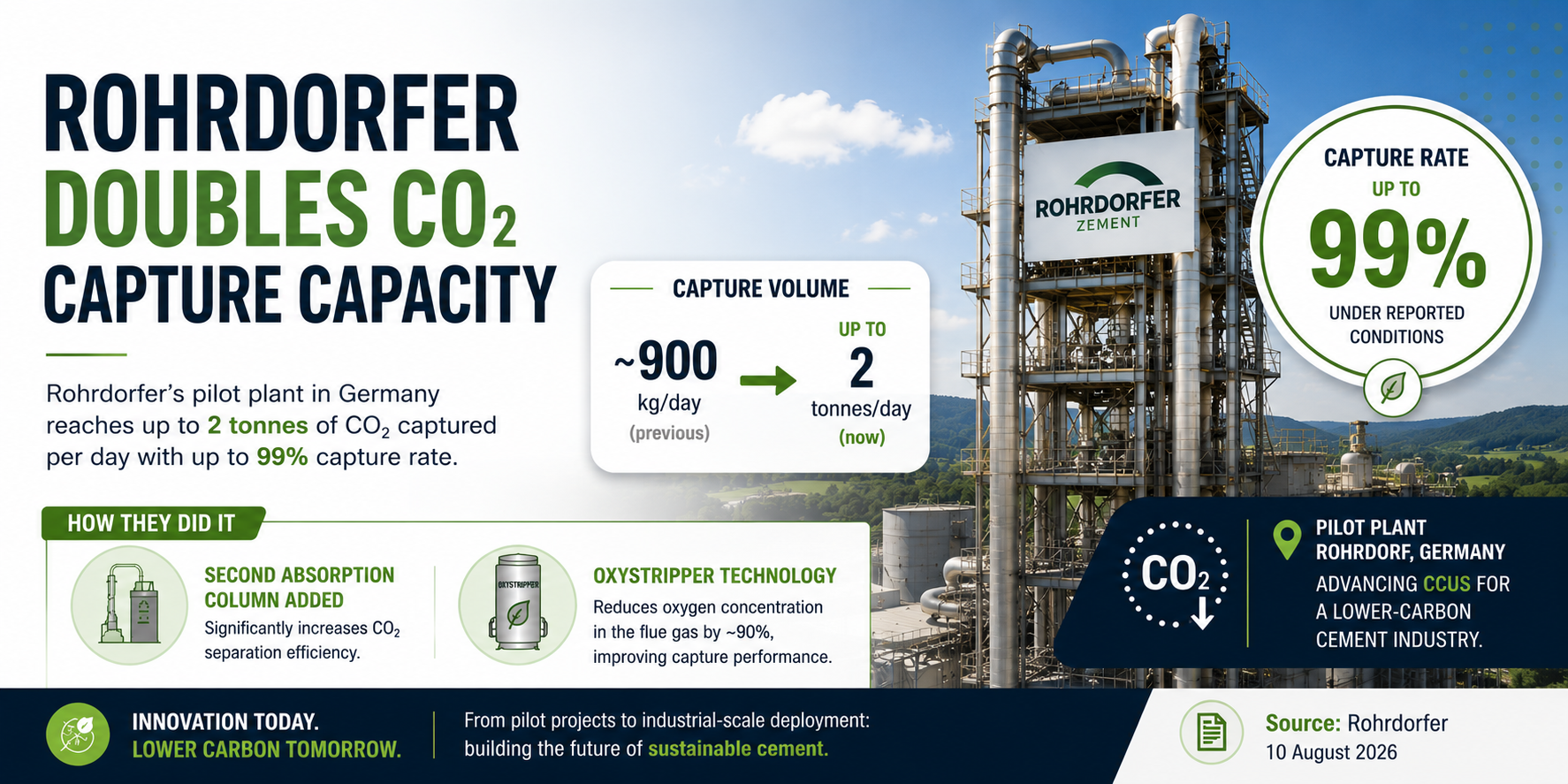
The company has increased its pilot plant’s capacity from approximately 900 kg to up to 2 tonnes of CO₂ captured per day, with capture rates of up to 99% under reported conditions.
What changed?
The increased capacity follows several technical improvements, including the addition of a second absorption column and the integration of Oxystripper technology, which reduces oxygen concentration in the flue gas by around 90% and supports the capture process.
Why does it matter?
Cement is particularly difficult to decarbonise because a significant share of its emissions comes from the chemical process of producing clinker not only from the energy used in production.
This is why carbon capture, utilisation and storage (CCUS) is considered an important option for addressing emissions that cannot be eliminated through energy efficiency, renewable energy or alternative fuels alone.
From Pilot Projects Towards Industrial Deployment
Increasing capture capacity is an important step, but the wider challenge is moving carbon capture from pilot projects towards industrial-scale deployment.
For the cement industry, this means developing systems capable of handling much larger CO₂ volumes while remaining reliable, energy-efficient and economically viable.
Rohrdorfer’s progress provides another example of how carbon capture technology is gradually advancing towards larger-scale application in cement production.
Source: Rohrdorfer, 10 August 2026
Read the original Rohrdorfer announcement