
Increased Fly Ash Content Cut Concrete Carbon by 20%
The path to lower-carbon concrete does not always require completely new materials. Sometimes, it means finding ways to use existing low-carbon materials more effectively.
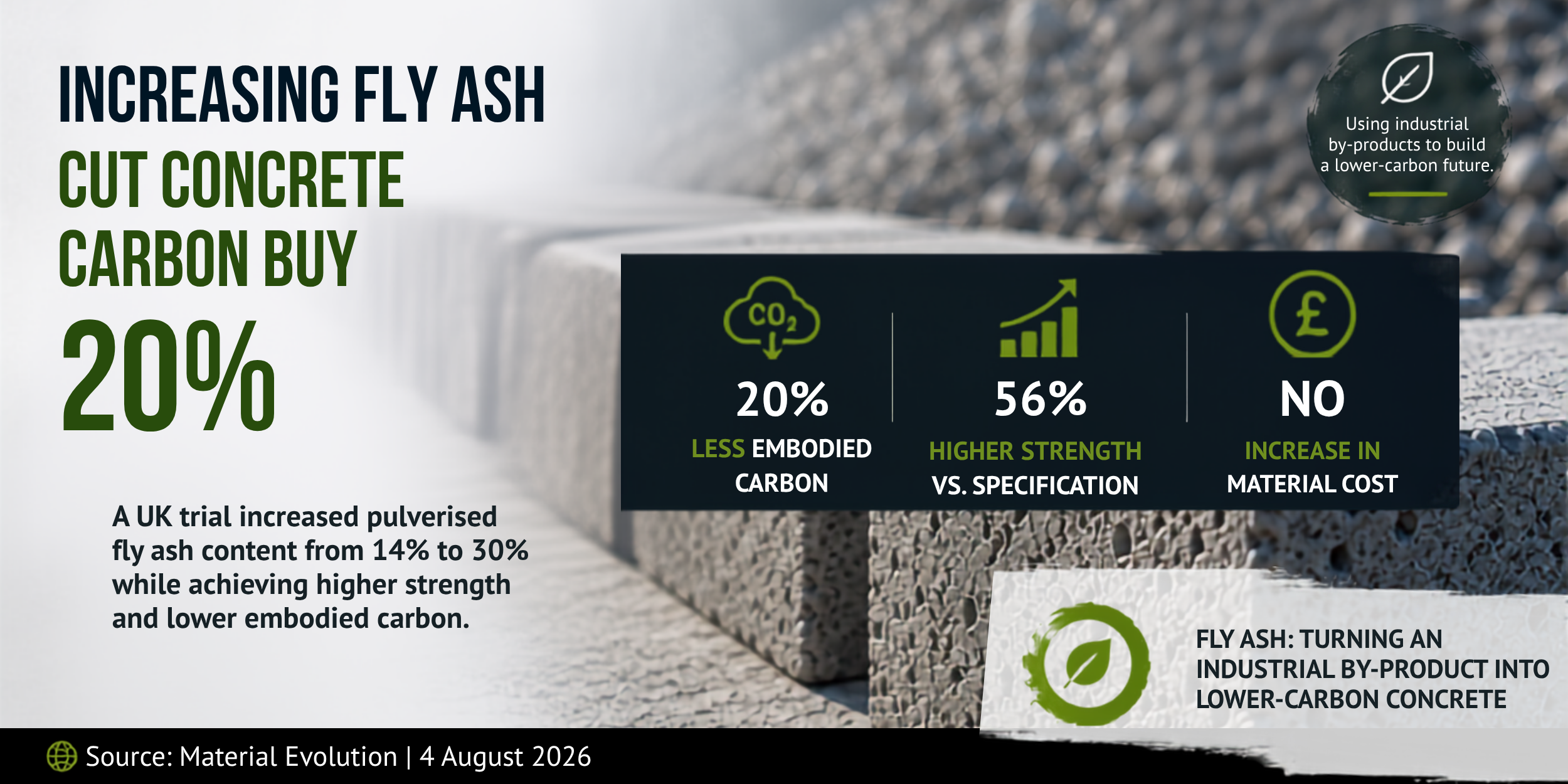
A recent UK trial involving Material Evolution, the Environment Agency and RPC Contracts demonstrates this approach. By using MevoXL, the team increased pulverised fly ash (PFA) content in precast concrete blocks from 14% to 30% more than doubling the amount used in the mix.
The results were notable:
20% lower embodied carbon
56% higher strength than the required specification
No increase in material costs
Why does this matter?
PFA is a well-established supplementary cementitious material (SCM) that can replace part of the conventional cement used in concrete. Increasing its use can help reduce the embodied carbon associated with cement production while making better use of an existing industrial by-product.
One of the challenges with higher SCM replacement rates is achieving sufficient early strength. In this trial, MevoXL helped address that challenge, allowing RPC to increase PFA content while still exceeding the required strength specification.
The case highlights a broader opportunity for the construction industry: decarbonisation does not always have to mean completely changing existing production processes. Solutions that work with familiar materials, existing plants and established processes could provide a practical way to scale lower-carbon concrete.
With more than 100 million tonnes of legacy fly ash estimated to be stockpiled in the UK, there is significant potential to make greater use of this existing resource.
📖 Read the full case study:
Material Evolution — Low-Carbon Precast Concrete Case Study
Source: Material Evolution | 4 August 2026
#FlyAsh #SCM #LowCarbonConcrete #Cement #Decarbonisation #Concrete #Construction #Sustainability