
Can Cement Decarbonise and Remain Competitive?
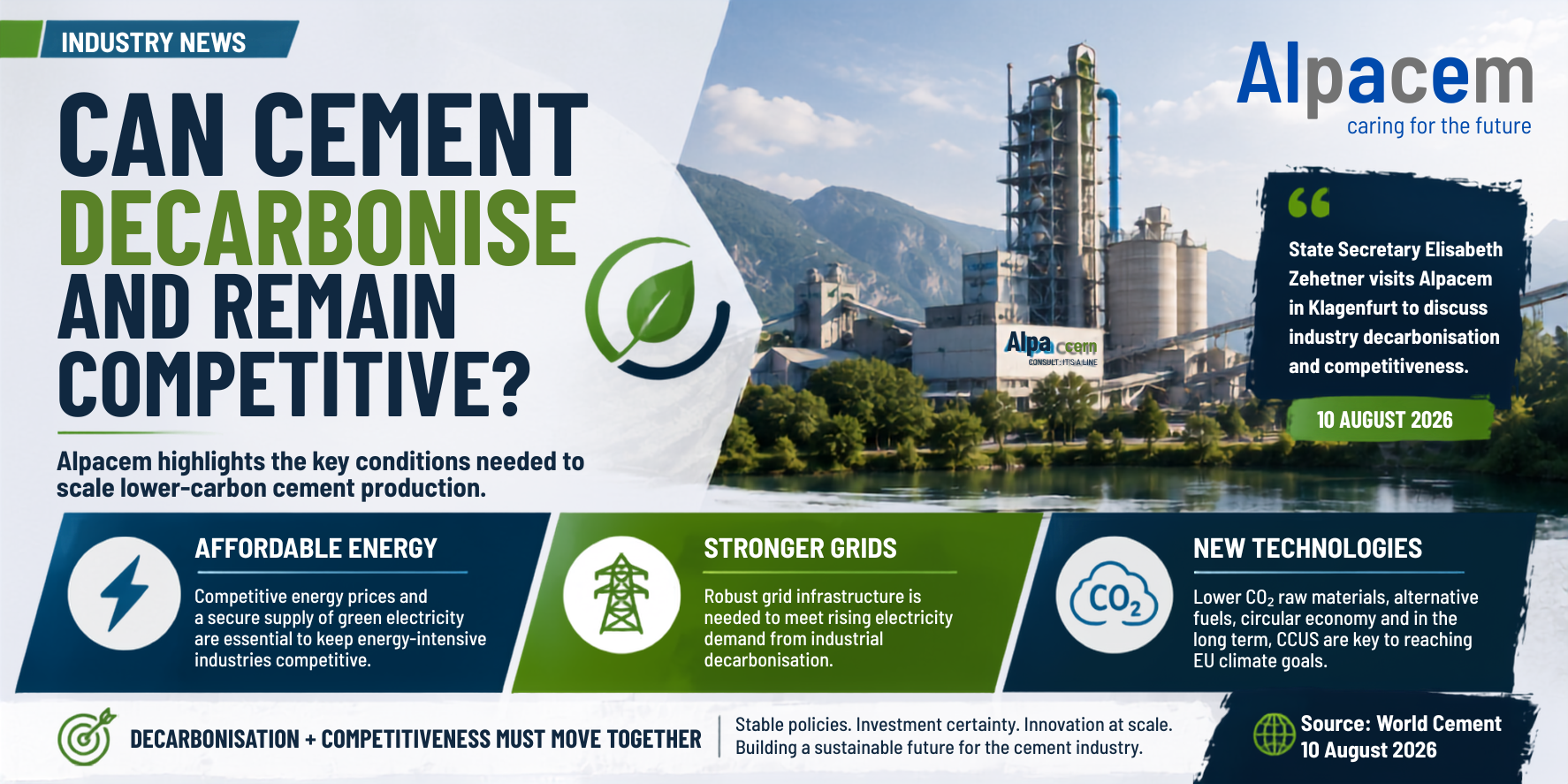
As the cement industry accelerates its transition towards lower-carbon production, technology is only part of the equation.
A recent visit by State Secretary Elisabeth Zehetner to Alpacem’s Klagenfurt site brought attention to a critical question: how can cement and concrete producers continue reducing CO₂ emissions while remaining competitive?
Alpacem is already working with lower-CO₂ raw materials and fuels and expanding circular economy practices. In the longer term, technologies such as carbon capture, utilisation and storage (CCUS) could play an increasingly important role in achieving deeper emission reductions.
However, many decarbonisation technologies come with higher electricity demand. This makes access to affordable energy, secure electricity supply and stronger grid infrastructure increasingly important for the sector.
And energy is only one part of the challenge. Large-scale industrial investments also depend on clear and reliable regulatory frameworks that allow emerging technologies to be tested, approved and deployed at scale.
The broader takeaway goes beyond Alpacem: cement decarbonisation cannot be driven by technology alone. Energy infrastructure, investment conditions and industrial competitiveness will all influence how quickly lower-carbon solutions can move from ambition to industrial reality.
📖 Read the full article: World Cement — State Secretary Zehetner visits Alpacem in Klagenfurt
Source: World Cement | 10 August 2026